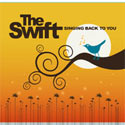

Early in 2006, The Swift seemed to be in trouble, with their name dropping from their former label Flicker Records' website, and an early exit of drummer Trae Drose. For most bands this could signify the end, especially since Drose's departure leaves only two original members, but few guys have worked harder than The Swift throughout the years, and this became evident when they resurfaced on Michael W. Smith's own Rocketown Records. With a fresh start ahead of them, The Swift also set out to redefine their sound, which is a goal that they definitely accomplish with Singing Back to You. The question is though, was this was a good decision on their part?
What would probably be called the signature sound of The Swift is a heavy piano line overtop laid back and simple, yet catchy guitar work. Upon their formation in 1998 as Regeneration X and then as Puddleglum, this was not the case (they were more of a worship/heavier rock band), but their change in direction to the sound of The Swift (2002) and Today (2004), really cemented their sound. In Singing Back to You, however, both of these elements take a back seat as most of the more fast-paced songs have been replaced with slower ballads. What is accomplished here is a successful shift towards a focus on worship with more songs that better highlight their faith, yet the album also compromises the foundation of the band at the same time.
The Swift's newest album is not boring; it's just not catchy and high paced, and it doesn't contain really any of the elements that made their other albums fun to listen to. In fact, Singing Back to You really does start off well with "Love Song" and "Rain Down," but unfortunately these two songs aren't really a good representation of what else is in store. "Nothing But the Blood" is a beautiful take on the traditional hymn too, and could have fit on some of their past albums, but the problem is the album does not really speed up at all after that, and it is just one ballad after another. Britt Edwards is one of the most talented pianists in the business, but fans who have heard The Swift's previous releases will be begging for the energy and variety found on those records, despite Edwards' skill. Fortunately, a little more than halfway through Singing Back to You, "What the World Will Never Take" saves the album and picks up the pace, but just for one song, and then the worship ballads begin again. Why did The Swift change their sound if what they were doing before worked so well?
There is probably a logical explanation behind this situation, though. Even though they tour constantly, The Swift has never received the recognition they deserve. The pay for a musician is low, the life is hard, and they have experienced many member changes and label problems. Honestly, the band is probably tired and has turned to the only person that won't let them down: God. Cleary evident in their usage of the hymns "Nothing But the Blood" and "At the Feet of Jesus" in their album, as well as in songs such as "Always Been With Me" that put their trust in God, The Swift has surrendered all that they have, proudly proclaiming to God "my hope is in You, my life is in You, my heart is in You." Most of the record is spent exalting God, too, not just calling out to Him in a time of need. "Your Name" is perhaps the best of these tracks, with Edwards crying that "Your Name is a strong and mighty tower" and that "nothing has the power to save, but Your Name."
With the direction that Christian music is taking towards bands writing more cryptic lyrics in order to appeal to wider audiences, The Swift is truly a gem among rocks. Still, their newest album, Singing Back to You can't help but be a little bit of a disappointment because the whole time it's playing, it just seems like there is potential musically lost somewhere, and there is a large void where it should be. Give The Swift credit for their boldness to proclaim the name of Jesus, but they just seem tired.
- Review date: 10/2/06, written by Flip Choquette
 Artist Info: The Swift's Discography
Record Label: Rocketown Records
Album length: 10 tracks, 40 minutes and 5 seconds
Street Date: October 10, 2006
Buy It: Amazon.com
Artist Info: The Swift's Discography
Record Label: Rocketown Records
Album length: 10 tracks, 40 minutes and 5 seconds
Street Date: October 10, 2006
Buy It: Amazon.com
|  |
  |


 "David," Starring Phil Wickham, Earns Highest-Grossing Faith-Based Animated Theatrical Opening of All Time "David," Starring Phil Wickham, Earns Highest-Grossing Faith-Based Animated Theatrical Opening of All TimeSun, 21 Dec 2025 16:05:00 EST |
| Phil Wickham Breaks Mediabase Record with No. 1 Song Fri, 19 Dec 2025 18:10:00 EST |
| B. Cooper Releases New Single, "Back," ft. 350 Fri, 19 Dec 2025 17:25:00 EST |
| The Undertaking! Releases "Only Left Alive To See The End" on CD Fri, 19 Dec 2025 17:15:00 EST |
| for KING + COUNTRY's "Do You Hear What I Hear" Goes Gold Tue, 16 Dec 2025 18:25:00 EST |
| Provident Entertainment Named Billboard's Top Christian Label for 2025 Tue, 16 Dec 2025 18:15:00 EST |
| Tribl Records Earns #1 Spot on Billboard's 2025 Year-End Gospel Charts Tue, 16 Dec 2025 18:00:00 EST |
Click here All News Headlines |  RSS
RSS






 CarriedOn Atlas: Revere - Single (independent)