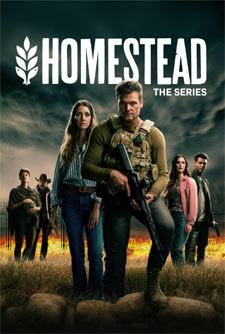


Homestead: The Series follows a family as they try to survive after a world-ending tragedy. (from IMDb)
For anyone who dabbles in the world of Christian media, Angel Studios is rapidly becoming a household name. Their theatrical release of the animated biblical film David has already grossed over $41 million in a little over a week, and Angel has also seen commercial and critical success with live-action dramas, including 2023's Jim Caviezel-led The Sound of Freedom (which grossed over a quarter-billion dollars at the box office) and this year's The Last Rodeo, starring Neal McDonough, who also plays a central role in Homestead.
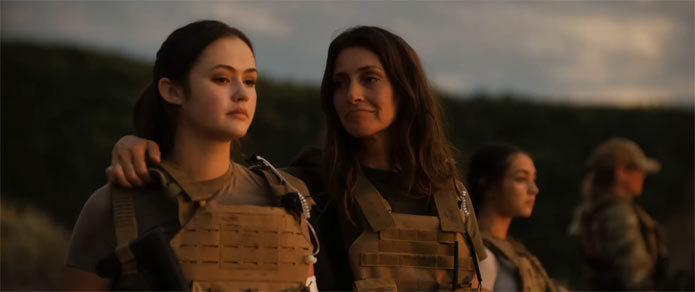
Before jumping in, a brief overview of Homestead's release structure is necessary. In 2024, Angel Studios released Homestead, a feature film that functions effectively as a stand-alone story, but was clearly designed as a springboard for Homestead: The Series. The film, and the first two episodes of the series, were shot together and released in December 2024. Production on the remaining six episodes did not begin until 2025, resulting in a staggered release, with the remainder of season one airing weekly in November and December 2025.
For the purposes of this review, both the feature film and the entirety of season one are considered together. (The film is an absolute prerequisite for the series.) Homestead is best described as a post-apocalyptic survival drama. The story opens with a major nuclear detonation in Los Angeles. While the cause is never explained, the ramifications are immediate and widespread. Amid the chaos, several families flee toward the only refuge they know: the Ross family's remote mountain compound, known simply as The Homestead.
The Ross family is led by Ian Ross (Neal McDonough), a man who has spent years preparing for exactly this kind of collapse. The compound is exceptionally well-equipped: hundreds of firearms, millions of rounds of ammunition, stored grain, meat rabbits, arable land, deep wells, and even a stocked pond are situated on the land. But the most prominent feature, physically and emotionally, is the gate. At first, the assumption is that the local police, National Guard, or FEMA will materialize to bring order. But as the days drag on, information itself fails to materialize. We are informed that the eastern seaboard allegedly suffered a Russian strike that destroyed the electrical and communication grids, but beyond that, the audience is left hanging as to what is happening in the wider world. With each passing day, more people arrive at Ian's gate.
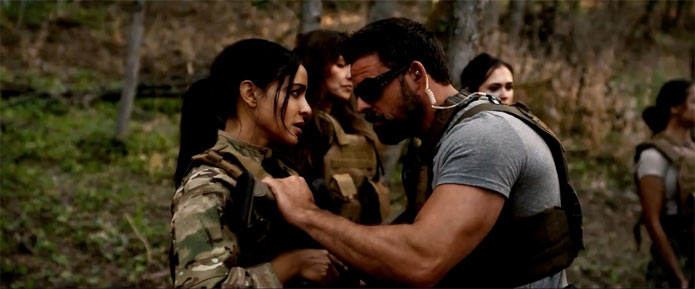
Further complicating matters is Jeff Eriksson (Bailey Chase), a former military operator and Ian's head of security. Jeff arrives with his own heavily armed militia crew, along with his wife and children. From this point forward, the series' central tension emerges: Jeff and his security team understand the likely trajectory of total collapse and believe decisive, often aggressive action is necessary. Ian, his wife Jenna (Dawn Olivieri), and many of the homesteaders disagree, favoring restraint and moral obligation toward their former neighbors. As the hungry mouths at the gate begin to multiply, we see extensive social and moral strain begin to unravel the coalition.
Having followed this project since its announcement, I was genuinely eager to see it fully realized. The cast includes several capable actors, and the creative team is not without pedigree. (Longtime JFH readers will immediately recognize the name Ben Kasica, former guitarist of Skillet.) McDonough is excellent as always, and Currie Graham delivers a memorable and angering performance as a bureaucratic antagonist whose cold pragmatism feels chillingly plausible. Charles Esten also brings a welcome gravitas to nearly every scene in which he appears.
The performances across the board are good, but occasionally uneven, though not always for the reasons viewers might expect. At times, the dialogue and speechwriting are genuinely overwritten or blunt in places. At other times, what may read as "bad acting" is more likely an uncannily natural portrayal of how real people speak and behave. The mainstream shift towards slick and witty dialogue sees Homestead occasionally suffer for being too human, awkward, and plain.
Faith is a constant presence throughout both the film and the series. Jenna Ross openly wears her Christian faith and frequently narrates journal-style reflections at the beginning and end of episodes, framing the unfolding collapse and its relation to how God is moving, in religious terms. Conversations about God's existence, will, and absence recur often. While this aspect will resonate strongly with Angel's core audience, many of the non-believing characters function largely as strawmen. Their anger toward God and resistance to faith are frequently caricatured and serve only as narrative devices. This muddies the focus of the series at times, and ultimately heads in no poignant direction.
The series also weaves in a restrained teenage romance between Ian's homeschooled daughter and Jeff's rough-around-the-edges son. Rather than functioning as a diversion, the relationship is deliberately governed by parental respect, moral boundaries, and the expectation of long-term commitment. This series' genre often treats collapse as permission to abandon order, but Homestead uses this subplot to argue the opposite: that ideas of future, family, rules, and responsibility stay meaningful and necessary, even when civilization fractures. It can be clunky, but it is a functional, stabilizing counterweight to the surrounding disorder rather than a distraction from it.
Where Homestead struggles most is in its inter-episode continuity. Important characters are introduced and then vanish without explanation. Several episodes end on dramatic cliffhangers that are resolved awkwardly or anticlimactically in the following installment. The series bears the DNA of a production that sometimes lacked a firm unifying hand, as if individual episodes were written without a comprehensive view of the interconnecting narratives and subplots.
This disjointedness becomes especially apparent midway through the season, when a pivotal narrative shift occurs off-screen. While clearly unintended from a storytelling standpoint, the resulting absence fundamentally alters the structure of the series and leaves several long-established tensions unresolved. The vacuum created by this change is felt immediately and never fully filled, contributing to the uneven pacing and tonal instability that follow.
That said, the series' willingness to allow major consequences to stand is a genuine strength, especially when contrasted with other media where deaths are seldom permanent and peril is without consequence. The action sequences and set pieces are solid, and the premise remains compelling throughout. However, Homestead frequently softens the brutality of true societal collapse. In reality, a world of starving populations, roving gangs, and competing militias would be grim and horrific. Homestead often sidesteps the ugliness of collapse and conflict, giving an off-kilter weight to the gravity of the situation juxtaposed alongside a Hallmark-style family drama. It is a net positive that this series remains accessible to a younger audience, but it does come at a felt cost.
Overall, Homestead is almost great. It serves as an excellent philosophical sounding board to host discussions about morality, proportionality, systems, obligations, just war, and the tension between responsibility and stewardship with generosity and openness. If this were a late draft, I would grant it five stars. What's most commendable is that Homestead aims higher than most entries in its genre, choosing to wrestle with moral responsibility, restraint, and long-term consequence rather than defaulting to spectacle or cynicism. Unfortunately, it just doesn't bring all of the moving parts together as smoothly as it could. The absence of a seasoned showrunner is keenly felt, leaving behind a handful of narrative and continuity gaps. Still, season one concludes on a solid note, bringing general closure while leaving room to grow and a few more threads to pull.
Stepping back, Homestead retains significant potential. A second season has already been announced, and if the creative team learns from the missteps of the first, meaningful improvement seems likely. Angel Studios has a genuine accomplishment on their hands, and despite its occasional stumbles, they've produced an engaging product that remains worth watching.
Disclaimer: All reviews are based solely on the opinions of the reviewer. Most reviews are rated on how the reviewer enjoyed the film overall, not exclusively on content. However, if the content really affects the reviewer's opinion and experience of the film, it will definitely affect the reviewer's overall rating.


 Russ Taff Bows Out of Fall Tour with Steve Taylor Russ Taff Bows Out of Fall Tour with Steve TaylorTue, 29 Sep 2026 01:11:02 EST |
| Switchfoot Extends Forever Now Tour Internationally with 2027 European Dates Mon, 28 Sep 2026 13:38:38 EST |
| Rottweiler Records Announces New Tundra EP, "Eternal: Eclipse," Out Nov. 27 Mon, 28 Sep 2026 13:32:05 EST |
| Justin Gambino Takes Home Two Josie Music Awards Mon, 28 Sep 2026 12:56:48 EST |
| Sean Rodriguez Follows a Rock Radio Breakthrough with "Just Like God" EP Sun, 27 Sep 2026 17:24:48 EST |
| Autumn's Descent drops "Adirondack," a Song About the Struggle to Release a Relationship Sat, 26 Sep 2026 13:53:35 EST |
| Matthew West Declares "Jesus Is King" on New Album, Out Now Fri, 25 Sep 2026 17:59:12 EST |
Click here for All News Headlines |  RSS
RSS








 Charles Billingsley Replay [StowTown]